
Beyond the Blood: What RUNX1 May Be Doing in the Rest of Your Body
By Dr. Katrin Ericson

At our 2026 RUNX1 Patient Meeting in Atlanta, I had the chance to share something I've long wanted to discuss with our community. Not the blood counts, not the malignancy data, but everything else.
The joint pain.
The GI symptoms.
The eczema.
The migraines.
The fatigue that doesn't fully make sense on paper.
We hear about these things from so many of you. And for too long, there hasn't been a good answer for why they're happening. I want to share what I presented this year, and what I hope you take away from it.
But first, please don't read this as a list of new things to worry about. That is the opposite of my intention. It’s also important to say clearly: not every symptom is caused by RUNX1-FPD. Common conditions still happen for common reasons.
But when many people in a rare disease community report similar symptoms, and the biology gives us plausible reasons to investigate, those symptoms deserve to be taken seriously.
This is also not meant to diagnose or replace medical advice. It is meant to help you notice patterns, document them, and have more informed conversations with your care team.
What I hope you take from this is permission. Permission to bring these symptoms to your doctors, to ask for referrals to specialists, to say, "I have RUNX1-FPD, and I'm learning that this condition affects more than just my blood, and I'd like to investigate this."
RUNX1 is More Than a Platelet Gene
Most of us know RUNX1-FPD through the lens of bleeding and bruising, and eventually, cancer risk. That's where the research started, and it's still critically important. But what we're learning is that RUNX1 does a lot more than just regulate your blood system.
RUNX1 is expressed (meaning the gene is active) in your skin, your gut, your nervous system, your joints, and your airways. And the immune cells it regulates, when they get dysregulated, release inflammatory signals called cytokines that travel through your bloodstream and touch every organ in your body.
That biology may help explain why so many of you experience symptoms that seem, on the surface, unrelated to a blood disorder.
What We're Seeing in the RUNX1-FPD Community
I want to share some of the patterns we're seeing. Not as conclusions, but as signals worth paying attention to.

Skin: About 65% of individuals in our community report skin issues, which may not be coincidental. RUNX1 is expressed in skin cells and plays a role in the skin's immune barrier. When that barrier is disrupted, allergens get in more easily, triggering inflammation.
GI symptoms: This is one of the strongest signals we see. Around 80% of patients in the NIH Clinical Research Study report some kind of GI symptom, including GERD (43%), constipation (40%), and difficulty swallowing (27%). The gut is the largest immune organ in the body, and RUNX1 appears to play a role in gut motility and in the cells that line and protect it. If you've been told these symptoms are unrelated to your diagnosis, I want you to know: they may be.
Joint pain and stiffness: RUNX1 regulates bone biology and cartilage development, and the same inflammatory cytokines we keep talking about are key drivers of joint disease. If your pain is worse in the morning and improves with movement, that points toward an inflammatory process, and that's something a rheumatologist can actually help with.
Migraines: We're starting to track this in the RUNX1 Patient Data Hub because we're hearing about it more and more. RUNX1 is expressed in pain-sensing nerves, and inflammation is a well-recognized component of migraines. If you're struggling with this, you now have some language to bring to your neurologist.
Fatigue and brain fog: Almost never caused by one thing. Usually, a combination of inflammation, potential iron deficiency from heavy menstrual bleeding, disrupted sleep from allergies, and the emotional weight of living with a rare disease. Each of those pieces is addressable.
What You Could Do Now
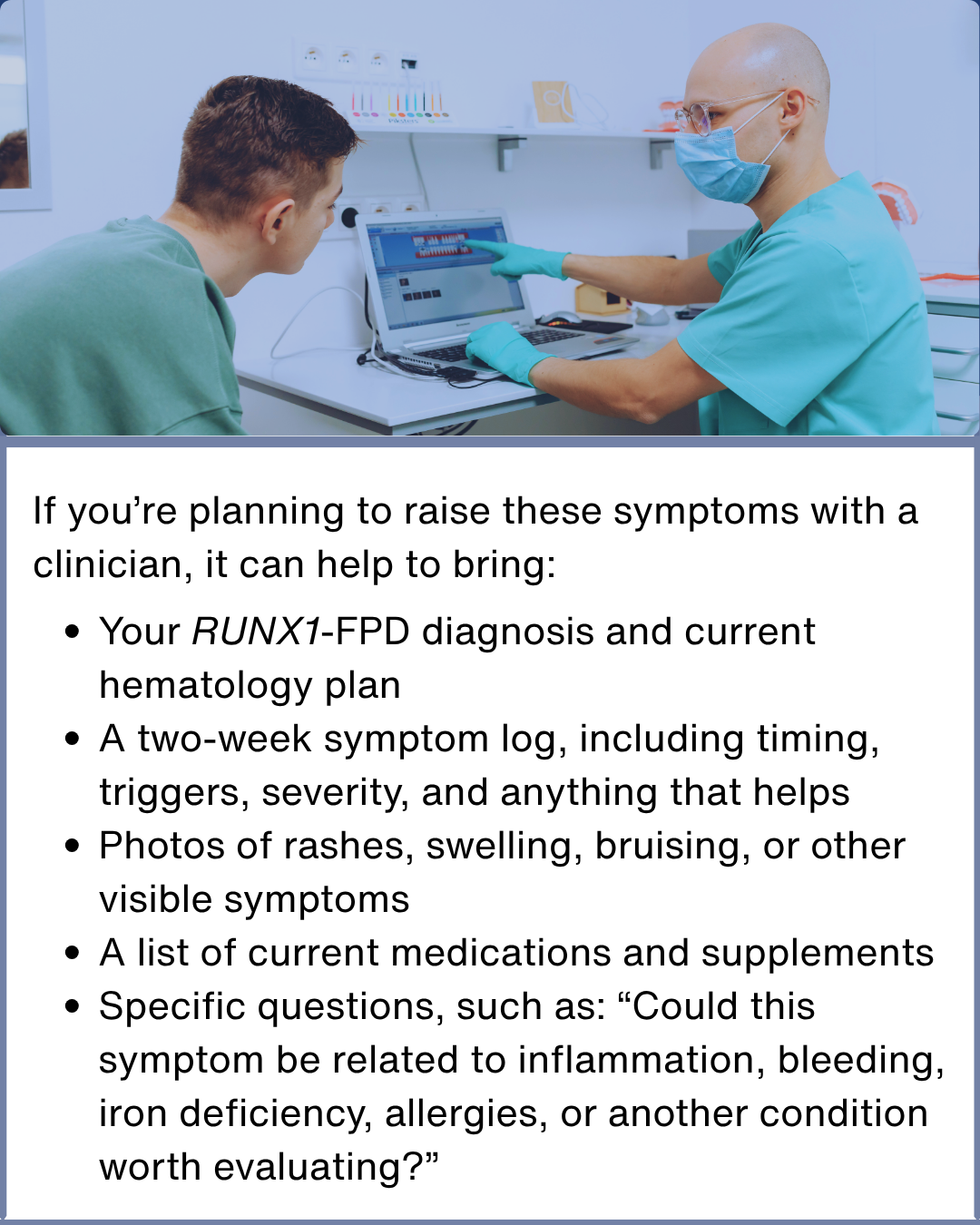
Keep a simple symptom log, even for two weeks. Patterns you notice are valuable information. And if you're enrolled in the RUNX1 Patient Data Hub, you already have a symptom tracker and journaling system built in. You can log everything in one place and even share it securely with your care team.
Ask about inflammatory markers if you're experiencing joint pain or fatigue. A standard CRP does not always rule out an inflammatory or rheumatologic process, and a rheumatologist can help decide what additional evaluation makes sense.
If GI symptoms are affecting your quality of life, ask for a GI evaluation. Treatments exist, and you don't have to just manage through it.
If heavy menstrual bleeding is part of your experience, talk to a gynecologist who understands bleeding disorders. This is very manageable, and doing so protects your energy and iron levels.
Focus on what you can influence. A fiber-rich, plant-forward diet is associated with lower levels of some inflammatory markers in broader population-wide research.
It is not a treatment for RUNX1-FPD, but nutrition, sleep, movement, and reducing allergen exposure may all support overall health.
What We Still Don’t Know
We are still learning which symptoms are directly connected to RUNX1 biology, which may be downstream effects of inflammation or immune dysregulation, and which may be common conditions that happen to occur in people who also have RUNX1-FPD.
That uncertainty is exactly why longitudinal patient data matter. The more consistently we track symptoms over time, the better we can separate coincidence from patterns that deserve deeper study.
Final Thoughts
Everything I presented came from two sources: laboratory and animal research on RUNX1 biology, and data from our own community through the NIH Clinical Research Study and the RUNX1 Patient Data Hub.
That second source is the one we can grow together. The more who enroll in the Patient Data Hub and share their experiences over time, the more clearly we’ll be able to see these patterns, study them, and eventually translate what we learn into better guidance. The symptom data you enter today becomes part of what we present at the next RUNX1 Patient Meeting.
If you are not yet enrolled in the RUNX1 Patient Data Hub, please consider joining. It takes about 20 minutes to get started, and the symptom data you share can help researchers and clinicians better understand what life with RUNX1-FPD looks like beyond blood counts alone.
I know that living with a rare condition means carrying a kind of vigilance that most people never have to think about. You're always paying attention, always connecting dots, always wondering what's related and what isn't.
I hope this conversation and the research behind it make some of those dots feel a little less lonely. You're not imagining it, and you don't have to navigate it without language. We'll keep sharing what we learn.
Click here for a list of references used to inform the original presentation and this blog.

About the Author
Dr. Katrin Ericson is the Executive Director of the RUNX1 Research Program, where she leads the organization’s strategic vision and guides its research funding priorities. She brings a unique blend of scientific expertise and leadership experience from both nonprofit and industry settings, with a career spanning drug development, research funding, and academic discovery. She is deeply committed to ensuring that scientific progress directly benefits families affected by RUNX1-FPD.